
Are We Having Fun Yet?
Musings Whilst Wandering in Vietnam
April 10, 2026
I have been thinking a lot recently about the role of ‘Fun’. Actually for the few months since I closed my full time school, I have been travelling, learning new things and having fun.
Last weekend, I attended an excellent seminar by Sifu Burton Richardson (who learned with many of Bruce Lee’s first generation students). He wrote the ‘Rules’ for the workshop on the whiteboard.
The first was ‘Honesty’- (this is about being honest with yourself- about what you are good at, and what you need to work on. Without this, you have no compass for your life, or your martial arts training.)
The last was ‘Have Fun’. So Good!
I decided to write a little about this, the most neglected part of life.
Often in martial arts- we see people being terribly serious (of course, if you have to defend yourself physically, that is a pretty intense situation!)- but is it fundamentally ‘serious’?
In Kung Fu- we often imitate animals. This is not so much their physical characteristics, after all- we don’t have sharp teeth or claws etc., yet we can to some degree get a feeling for the spirit of a Tiger, for example, and ‘channel’ that into our practise. Many of the traditional martial arts forms were derived from Shamanistic practises in this way.
Yes, something occurred to me: How do Tigers actually learn? I mean, they don’t ‘train’ as such, right?
Like many animals- they learn by play. Watch tiger cubs practising- they roll around and have fun. Claws are in, they ‘nip’ not bite. But they are learning incredibly complex three dimensional movement patterns- without knowing calculus or mechanics, they are intuitively understanding acceleration, angular momentum, tactics, when to be still, when to move- more things than could possibly be described in words.
Tiger cubs do not need ‘discipline’ because they are having a good time. Nature ‘rewards’ play with neurochemicals that feel good, like a drug.
Human kids are the same, except ‘civilisation’ often quashes our natural instincts and rewards kids for sitting still, being quiet etc. The result of this is a being divided from itself- a constant tension between how the child ‘wants’ to act, and how it feels it ‘should’ act.
This started after the industrial revolution, and was about school preparing people for the unnatural environment of a factory job. A very different environment than the one we evolved to thrive in.
I read recently of a school in the Sweden where the headmaster was pressured to cut down the already meagre time for ‘physical education’ in order to make time for all of the academic requirements. He responded by rebelling completely, and doing Physical Education every single day. Here is the surprising thing: The students grades all IMPROVED.
With advances in modern neuroscience, this is perhaps not so surprising.
Our brains evolved precisely to navigate complex environments, and higher degrees of physical intelligence are associated with better neural connections and general intelligence, wellbeing, motivation etc.
Indeed, in tech companies like Google- they often pay genius level people just to ‘goof off.’- they give them a playground, video games etc. access to a lot of toys and no pressure. This is very intelligent behaviour- real creativity cannot be forced, all you can do is provide an environment in which it can thrive, and wait…
Similarly in martial arts: Schools that encourage fun, and play are often, paradoxically, producing better fighters. I mean- Kung Fu looks like a tiger when it goes for the kill, but Brazilian Jiu Jitsu looks a lot more like tiger cubs playing. Some traditionalists argue that play and combat sports are not serious enough to prepare you for the realities of a violent conflict- but, honestly- what is?
Certainly -pretending to be dangerous, posturing and making ferocious expressions is not a lot of use if you have never engaged in any play fighting, have never actually used your techniques against someone who was offering any meaningful levels of resistance- it’s just a performance.
And I don’t think anyone would say that a Tiger is less effective at killing a deer because it played too much as a cub, and had gotten soft, ha!
There is, of course, a ‘killer instinct’ that must be turned on. Without that- If you engage a dangerous opponent who is intent on hurting you or your family, in the spirit of play or a sparring match- you are unlikely to prevail.
Techniques and tactics must adapt- the ‘claws and teeth’ come out.
You must understand when to ‘play’ and when to ‘fight’.
But- have you ever seen an animal ‘Train’ or ‘Practise’ that? Of course not- that is it’s true nature.
That happens spontaneously, it cannot be forced.
The skills that need to be ‘trained’ are precisely those that can be sharpened through play.
THAT’S WHAT PLAY IS FOR.
But, this brings me to the main point of my rambling-
Modern people read the research- neuroscience, education, health etc. and say:
“Of course, I should play and have fun, because it is good for me. It will improve my performance and make be better.”
This is exactly missing the point! If you are doing it ‘because it is good for you’- you are not doing it right!
There is absolutely NO REASON to play- even though all of the benefits are very real, it does not have anything to do with the logical thinking of the ‘Left Hemisphere’ of our brain.
REASONING is a human creation- a very powerful one to be sure, but is not for ‘reason or purpose’ that we do anything. Rather, it is a post-rationalisation. FUN is more primary.
I had a student join my Tai Chi class and explained how she had read it was good for bone density, cognitive health, balance etc. I said it certainly was!
But she hadn’t ever seen it- didn’t know what it was- just that she was told by her Doctor that she OUGHT to do it because it was good for her.
Such students generally don’t last, unless they fall in love with the practise. When I first saw Tai Chi, I was mesmerised, I really loved it. Releasing tension, and flowing through the routines, feeling the joints and tendons, allowing the energy to form shapes like floating clouds and flowing rivers…Other people think its slow and boring.
That’s cool. We all have different personalities and are drawn to different things. The same goes for music, art and food.
But here is the thing- you do it for no reason other than it feels so good, you love the flow or whatever, and all of the ‘Benefits’ come along for the ride.
But, if you grit your teeth and develop a ‘discipline’ because you ‘ought’ to do it every day- then it’s just one more thing to stress out about.
Recently- I have been seriously cultivating the art of ‘Goofing Off’:
As I drink my morning coffee, I practise my Rubik Cube.
I started this as a way to get off of my mobile phone- something to do with my hands etc. In other words, for a purpose.
Then it ‘grabbed me’- I could solve it easily and started looking for faster, more efficient ways- now it is a kind of meditation for me: The tension between algorithm/muscle memory, and intuition. The two dance, and my hands move faster than my rational mind can keep up. It is a kind of ‘flow state.’
(I could talk about the cognitive benefits here of being able to spot pieces, invert, rotate and solve them whilst looking for the next move- can you see the relevance to martial arts here? 😉 )
Then after my ‘formal’ meditation (Which is also completely useless, I just sit), I do some balancing on my ‘slackline’- this is like a mini tightrope. It really fires up my core and stabiliser muscles and improves balance and proprioception. But that’s not why I do it- I’m having fun and trying not to fall off.
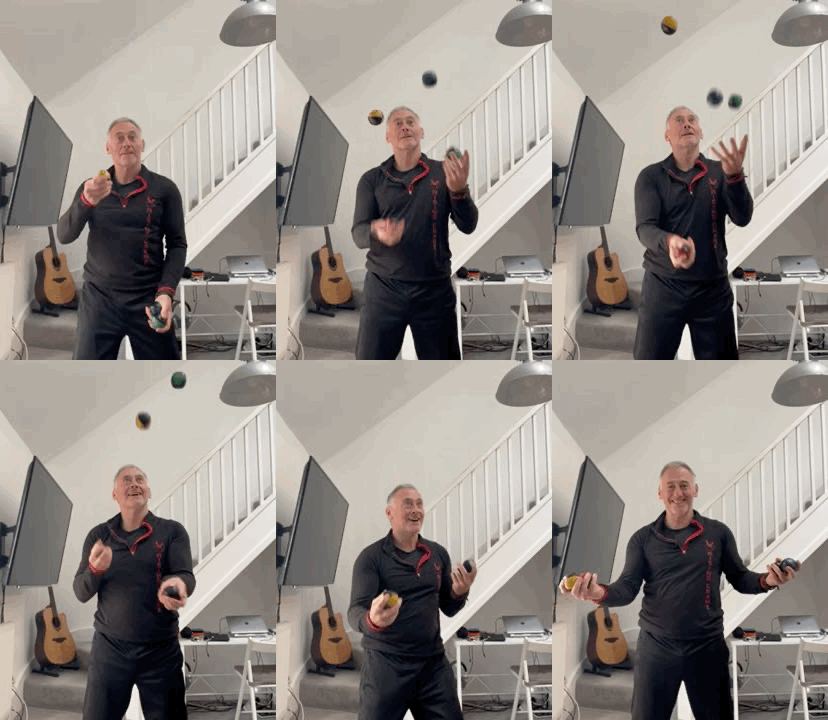
Then I practise juggling- I’m working on a four ball juggle, which has been a challenge for some time- and I am FINALLY able to do it! Best of all- it’s completely useless and there is no practical purpose whatsoever!!
OK- I am being facetious here- I could say how much my hand/eye coordination has improved, and how much faster my reflexes have gotten. (Last week I knocked a cup off of the shelf, caught it and put it back, before I consciously realised I had knocked it off.)
So – these things done in the spirit of play (or fun) rather than for their benefits, have, paradoxically, been very beneficial. I have not had to develop any ‘discipline’ or ‘self control’ because its precisely what I would do anyway, when I am not trying to do anything that is ‘good for me’.
My insight is this:
What if that which you just do naturally because it is fun, is exactly the right thing?
What if the feeling of ‘fun’ is your brain saying: ‘Yes! More of this!’?
What if we constantly punish ourselves, discipline ourselves, take it all terribly seriously- and that actually gets us LESS?
I can hear some of my friends getting really upset at this suggestion: “It’s alright for you! How would it be if we all just goofed off, and never got any serious work done?”
I perhaps need to choose my words carefully, as many people take all of this stuff EXTREMELY seriously, and would be very offended if they were told that all of their ‘effort’ was just an unnecessary muscular strain, that had absolutely nothing to do with performance.
In Taoism, it is sometimes called ‘The Law of Reversed Effort.’-the paradoxical principle that the harder you consciously try to force an outcome, the less likely you are to achieve it.
What do juggling, tightrope walking and Rubik Cube have in common? You cannot improve by adding more ‘Effort’- it is very clear that concentrating too hard, just gets in the way. On the contrary, you need to have a kind of ‘Faith’. I mean this in the sense of a ‘letting go’ of trying to control the outcome. Then, paradoxically, things just fall into place.
In the movie ‘Enter The Dragon’- Bruce Lee is talking to his Master about ‘the highest level’. He holds up his fist and says- “And when there is an opportunity, I do not hit… it hits all by itself..” This was speaking of the same phenomenon -unconscious response without the ‘Ego’ or sense of self inhibiting the flow state.
As a teenager, this made a big impression on me, and I looked for ‘Zen’ in all of the esoteric practises of China-Buddhism and Taoism etc. Of course- if there is any ‘secret’- it is missed by looking for it. Actually, it is the most simple and ordinary thing- but crucially- gets lost by seeking.
Ironically, I found it by goofing off.
Now- one objection I have heard is that if everyone just ‘goofed off’ they would scroll social media all day, look at internet pornography, eat junk food and generally become slobs. How do I answer that?
Actually- I don’t think that is true at all.
Social media, ultra processed food, internet porn, junk entertainment- all hijack our dopamine systems, so they feel like ‘fun’ at the time- but there is a crucial difference:
Afterwards, instead of deriving a sense achievement, you get a sense of regret.
Sure- eat the junk burger, drink the sugar laden Frappuccino, spend an hour scrolling ‘reels’ on instagram- and answer ‘HONESTLY’- was that fun? Are you happy you did that? Do you feel good now?
This is in no way meant to be ‘Preaching’- I am absolutely NOT telling you what you OUGHT to do, just suggesting that you ask yourself ‘Is this really a good use of my time?’
I think, if you are sensitive, you will see that it leads to suffering.
On the other extreme: People obsess about ‘discipline’ – eat no carbs or sugar at all for a week, then the part of their unconscious that has been repressed, pops up, possesses them- and they eat an entire box of ‘Krispy Kreme’ donuts and then beat themselves up about it.
So what is the ‘Middle Way’? Perhaps if we avoid junk (for the eyes, for the stomach, for the soul) because we can clearly see that it leads to suffering- have an environment that is close to the environment we evolved to be in- fresh, seasonal foods, sufficient sleep, meaningful social connections, art and culture, and then, within that environment JUST HAD FUN?
Would you really want to just be a slob, when there is so much more enjoyment to be had?
There was an experiment in the 1970’s with rats in a cage. There were two bottles of water, one had morphine in it. Sure enough- most of the rats chose the drugged water, to the point of overdose and death. The conclusion was that people will always choose the unhealthy option, we are wired for addictive behaviour.
Later, another scientist had an insight that the rats were in cramped cages, and repeated the experiment, but this time the rats had plenty of room, toys to play with and lots of opportunity to socialise- THIS TIME, MOST OF THE RATS DID NOT DRINK THE MORPHINE WATER, and those that did, did not overdose. So it was not about ‘discipline’, it was about ‘environment’.
What if all of the unhealthy behaviour that we see in our culture is not because of ‘lack of discipline’ but rather, poor environment? Sure- some people have great self discipline, and can ‘do the right thing’ when most can’t, but that is rare, and I doubt it can be learned or forced.
I honestly believe our current culture is ‘sick’. Just sit in a cafe and watch people walk by for a while. How many look healthy? How many look happy? I don’t think it’s my age bias when I say that it has gotten much worse lately. For all of the technology- people are worse than before. Screen addiction and ultra processed food are likely the main culprits, and crucially- lack of meaningful social interactions that are not ‘online’. An interesting experiment might be to ‘unplug’ for a month, eat real food, sort out your sleep patterns, make conversation with others, and have fun! Don’t TRY to be healthy- listen to your body, move when it wants to move, stretch, bend climb etc.
I have been teaching martial arts my entire life, and continue to learn, study and improve. People say- ‘wow you must have incredible self discipline!’ People who know me well would laugh at that suggestion- I am as lazy as the next person, It’s just that I enjoy martial arts, I derive great pleasure from it, and miss it if I don’t practise, even for a couple of days. It’s effortless for me.
So I am going to close out with some advice that seems to be the exact opposite of what everyone online is telling you:
First- find something you actually ENJOY. That is- what would you do for fun, even if it wasn’t ‘good for you’. I gave my examples, but we are all different.
There is no point doing something if you would rather be doing something else.
My girlfriend likes to go for a relaxing 10Km run on a Sunday morning.
Personally, I would need to be chased by a horde of Ninjas to motivate me to do that- never mind for fun.
But that is the point. Find what YOU love, not what you think you OUGHT to love, or what other people love.
“Don’t make a practise or a discipline to ‘achieve’ anything. Listen to your body. Have Fun.”
You might surprise yourself and achieve more anyway- but that’s not the point 😉
